

What is Apitherapy?

Apitherapy /ˌāpiˈTHerəpē/* is the art, practice, and science of partnering with the honey bees and the gifts of their hive to support your whole-being health.
Gifts of the hive include bee venom (apitoxin), honey, propolis, beeswax, pollen, bee bread (perga), royal jelly, hive air (apiair), and even the sounds of the hive herself.
Apitherapy is one of the oldest and most well-documented healing relationships that humans have ever cultivated. Today, it is an essential part of healthcare in advanced countries around the world—and thanks to the hard work of many, such as the American Apitherapy Society and my teachers Joy & Eric McEwen, it is finally gaining real momentum United States.
As we bear unprecedented disease, disconnection, and medical costs that fail to address root cause, Apitherapists backed by growing research are coming forward to illuminate what healers have always known: that honey bees hold a capacity for improving human health far greater than just their sweetness.
*from the Latin apis mellifera, meaning honey bee
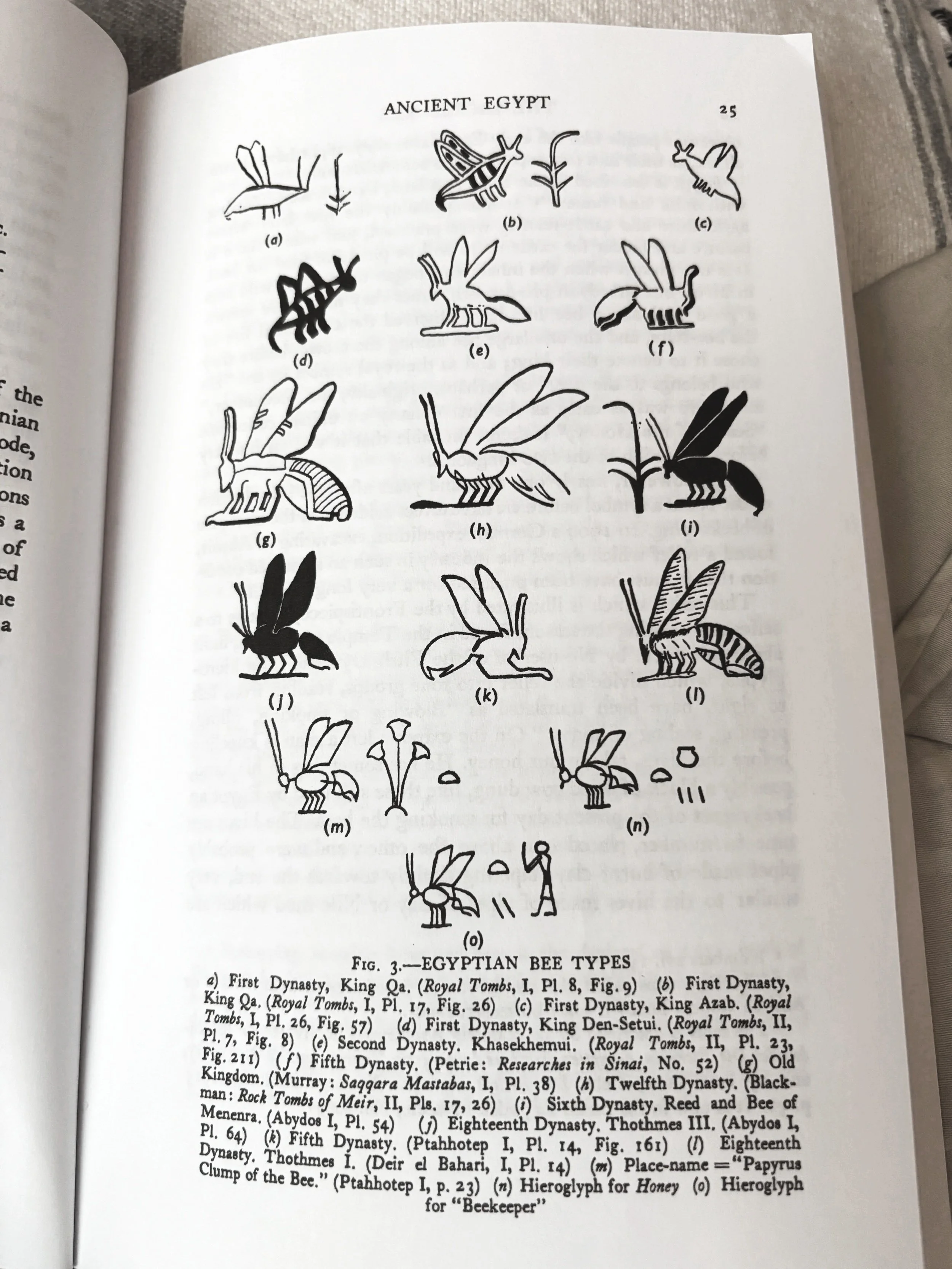
This photo of Egyptian bee heiroglyphs over time is from a book I have and highly recommend called The Sacred Bee in Ancient Times and Folklore By Hilda M. Ransome that covers many of these Apitherapy & ancient honey bee healing relationships briefly outlined here as well as many, many more.
Before it had a name, Apitherapy hummed at the heart of every culture with access to honey bees.
-
The oldest known surgical text in the world—The Edwin Smith Papyrus—prescribes honey for wounds, burns, and infections.
The Ebers Papyrus (Egypt, 1550 BCE) contains roughly 500 remedies that include honey–used for wound care, eye conditions, digestive complaints, and as the base for countless other medicines.
Honey was found in Tutankhamun's tomb (~1323 BCE) and was still edible
-
The Yao people of Mozambique have practiced cooperative honey hunting with the honeyguide bird for thousands of years, in what may be the oldest continuous human and animal mutualism on record.
-
Hippocrates was prescribing bee venom for joint pain and Aristotle wrote about bees and their healing gifts in his Historia Animalium.
-
The Celtic peoples of Iron Age held bees and honey as sacred. Druids used honey in healing rites. The Norse and Germanic peoples treated mead as the drink of the gods, and Slavic forest beekeepers practiced bortnictwo, keeping colonies in living trees and harvesting honey, propolis, and beeswax–a tradition that survived in the wild forests of Belarus and Poland into modern times.
-
One of the most influential medical texts in history, Avicenna's Canon of Medicine recommended honey and propolis for vitality, longevity, and a wide range of ailments.
-
Ancient Chinese medicine, with roots going back several thousand years, used honey, bee pollen, and royal jelly as foundational tonics. Royal jelly was at certain times reserved for emperors as an aid to vigor and longevity, and bee pollen was held in similarly high regard. It’s even speculated that the first acupuncture needles were bee stingers!
-
The Donguibogam, Korea's foundational medical encyclopedia completed in 1613, contains detailed references to bee venom, honey, and other hive products as medicine. This deep lineage is the foundation of modern Korean apipuncture, still practiced today as a formal branch of Korean Oriental Medicine.
-
The Vedic and Ayurvedic traditions of India elevated honey, called madhu, to one of the most sacred medicines in the system, where it remains a cornerstone today, paired with herbs to deepen and carry their effects.
-
The Inca civilization of South America used propolis as a key medicine for fever and infection, working with the native stingless bees of the Andean and Amazonian regions for both healing and ritual. Mayan civilization domesticated the stingless Melipona bee for centuries, using its honey in medicine, ritual, and trade across Mesoamerica–and still does today.
-
Aboriginal Australians have harvested honey from native stingless sugarbag bees (Tetragonula and Austroplebeia) for food and medicine for tens of thousands of years, in one of the oldest unbroken honey traditions on Earth.

Services
Explore our range of services designed to help you move forward with confidence, wherever you're headed next.
Clients
We’re honored to have our work recognized in a range of publications, platforms, and press features.